

Word problems can feel like puzzles wrapped in words, but they're a fantastic way to apply math in real-life situations. However, for many students, deciphering and solving word problems can be intimidating. The good news? With the right strategies, tackling these problems becomes much easier and even enjoyable! Here's a step-by-step guide to mastering word problems with confidence.
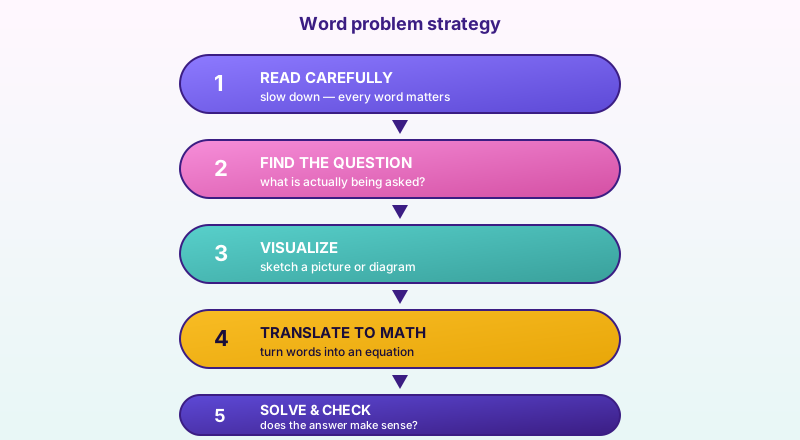
1. Understand the Problem
The first and most critical step is to fully understand the problem.
- Read Carefully: Read the problem slowly and carefully, paying attention to all the details.
- Highlight Key Information: Underline or highlight numbers, keywords, and phrases that provide clues about what's being asked.
- Ask Yourself Questions: What is the problem asking for? What information is provided? What do you need to find?
2. Identify the Question
Word problems often include extra information to distract you. Focus on what the problem is asking:
- Look for phrases like "How much," "What is the total," or "What is the difference."
- Rewrite the question in your own words to clarify what you need to solve.
3. Visualize the Problem
Creating a visual representation can simplify even the trickiest problems:
- Draw a Picture or Diagram: Sketching can help you see the relationships between the numbers and components.
- Use a Table or Chart: Organize information into a chart to better understand patterns or relationships.
- Think of Real-Life Context: Imagine the scenario described in the problem to make it more relatable.
4. Break It Into Smaller Parts
Word problems often contain multiple steps. Breaking them into smaller parts can make them easier to solve:
- Solve one part of the problem at a time.
- Write down each step clearly to keep track of your work.
- Recheck each part before moving to the next.
5. Look for Keywords
Certain words and phrases can provide hints about the math operation needed:
- Addition: Total, sum, combine, altogether, in all.
- Subtraction: Difference, less, fewer, remaining, how much more.
- Multiplication: Times, product, each, per, groups of.
- Division: Divided, quotient, share, split, equal parts.
Recognizing these keywords will guide you toward the correct operation.
6. Write an Equation
Translate the word problem into a math equation:
- Use the numbers and keywords to build a mathematical expression.
- If the problem has unknowns, represent them with variables (e.g., "x" or "y").
Example:
Problem: A bag contains 5 apples, and 3 more are added. How many apples are there now?
Equation: 5 + 3 = x
7. Solve the Problem
Once you've written the equation, solve it step by step:
- Perform calculations carefully.
- Use estimation to check if your answer is reasonable.
8. Check Your Work
Always double-check your solution to ensure accuracy:
- Re-read the Problem: Make sure your answer addresses the question.
- Review Calculations: Verify each step of your math work.
- Does It Make Sense?: Ask yourself if the answer is logical in the context of the problem.
9. Practice with Real-Life Scenarios
The more you practice, the better you'll get! Here are some examples of real-life word problems to try:
- Shopping: "You have $20 and buy items costing $12.50 and $4.75. How much money do you have left?"
- Travel: "If a car travels 60 miles per hour, how long will it take to cover 180 miles?"
- Cooking: "A recipe calls for 2 cups of flour. If you want to double the recipe, how much flour will you need?"
10. Stay Positive and Patient
Word problems require both logical thinking and perseverance. Don't get discouraged if you don't solve it right away. With practice, your skills will improve, and the process will feel more natural.
Conclusion
Mastering word problems is all about breaking them down into manageable steps and using strategies like visualization, identifying keywords, and writing equations. By staying organized and practicing regularly, you'll find that word problems become less intimidating and even rewarding.
Remember: Word problems aren't just a test of your math skills—they're a way to develop critical thinking and real-world problem-solving abilities. So, take a deep breath, tackle them one step at a time, and enjoy the challenge!